Bob Waldmiller
Originally published May 1993
When we left our story last time, Rocky and Bullwinkle were flying precariously close to powerlines and rising terrain in a Piper Cherokee 140 loaded to max gross weight with Aircraft Spruce Catalogs purchased at the Copperstate Fly-in. Having overestimated their aircraft's performance based on data presented in the operating manual means almost certain doom for our heroes. Little did they know that the manual had been written by the evilest of villains, Boris Badenov...aka..."I want to sell more airplanes so I'll fudge my performance numbers a bit--Piper."
"Look Boris, moose and squirrel are headed right at that mountain!"
"Yeah, isn't it wonderful Natasha, moose and squirrel will smack into mountain and we get Aircraft Spruce Catalogs for free."
As the picture looks more and more bleak, Rocky speaks the obvious. "I think the performance manual for this airplane was a little optimistic, Bullwinkle."
"I'll say! And in a few minutes we won't have much use for it either!"
Moose Modifies Mountain!
--OR--
Mountain Modifies Moose!
In a fit of panic, Bullwinkle tossed the operating manual out the window. Miraculously, the airplane started to climb which allowed our heroes to return safely home. However, in their next flight in the same airplane, Rocky and Bullwinkle found themselves in a similar situation 7500' MSL over the Mojave Desert. This time 120 lbs lighter, the airplane barely achieved a 200 ft/min rate of climb. Additionally, the engine was turning about 100 to 150 RPM less than required for the 75% power setting they desired.
"Boy, Rocky, this performance is depressing. Maybe if I work a little magic with the engine controls...Nothing up my sleeve...Presto!"
"What'd you get, Bullwinkle?"
"Oh, not much. Just this magazine...the Pacific Flyer--Swimsuit Edition."
"That's not what I mean, Bullwinkle. How's the engine?"
"Don't bother me now, Rocky, I'm reading..."
Does this mean their airplane will always have marginal high altitude performance or is there an unknown engine problem?
Given the above information, it appears that the engine is only producing 65% power rather than the desired 75% at wide open throttle. The first thing we'll do is give the engine a thorough inspection. Let's see, new spark plugs, new ignition harness, mag timing checked, cylinder differential pressure is in the mid 70s over 80 on all four cylinders, carb heat box rebuilt to replace a worn out seal and bushings, throttle plate moves to the fully open position, carb venturi looks ok, fuel and air filters all clean, and the mixture control operates normally. During run-ups the engine leans very smoothly like it always has, i.e. there is no engine shaking or backfiring as the engine is over-leaned which indicates to me that all four cylinders are getting pretty much the same mixture. Without the benefit of an EGT or a CHT it's difficult to be precise in my analysis, but I believe there are no defects in the engine itself. A tachometer check indicates that my tach is reading 50-60 RPM low throughout the entire operating range so I'm turning close to the required static RPMs although it's still 25 RPM low. Given the fact that we're 2300' above sea level while doing the run-up might have something to do with that however.
Now, what about the lack of climb performance? Time for the one hour flight test program! My objective is to learn as much as I can about the airplane's performance by doing a simple rate of climb check. Since I don't have calibration charts to correct for pitot-static system errors or instrument errors, I'll make the BIG assumption that the errors are reasonably small. Also, I presume Piper did a reasonable job of locating the pitot-static system on the airplane since certifying an airplane to Part 23 standards requires the airspeed system error to be within 3 percent or 5 kts--whichever is greater. Still, I'm making a BIG assumption here. To generate a little credibility however, I'll fly the airplane through a low speed ground course to verify my assumptions. 'Nuff said about instrument errors.
The procedure is simple. After setting the altimeter to 29.92, I'll climb at the best rate of climb speed (85 mph) from 500' AGL to 8000' pressure altitude. At 500 foot increments, I'll note the total elapsed time on the stopwatch (starting from a reference altitude) and the outside air temperature. During the climb, I'll keep adjusting the mixture to achieve best power on the engine and all the while, the throttle will be wide open. Simple, huh?
Still with me? Great! Before I started my climb, I performed an airspeed calibration test by flying both ways through a 4 mile ground course. The first two runs were done at 80 mph indicated in both directions and the second two runs were done at 85 mph indicated. A few minutes of electronic whiz-wheel time to calculate the average ground speed through the course along with my true airspeed revealed that my total airspeed system errors are less than 1 mph at both 80 and 85 mph! That's fantastic! How'd Piper do that?
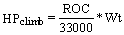
Ok, back to the rate of climb data. I took the liberty and already did some number crunching in order to correct my data to standard atmosphere conditions. In addition, I calculated the actual rate of climb (ROCact) for each altitude based on the corrected altitudes and the stopwatch timing values. Since there is some scatter in the data due to vertical air mass movement during the test flight and altimeter errors, I applied a linear regression fit to the ROCactdata to smooth it out (ROClr). Finally, I determined the horsepower required to climb at those rates using the following equation:
Where ROC is the rate of climb in feet/minute and Wt is the aircraft weight in pounds. Table 1 is a summary of the raw flight test data and the calculated data.
Since the purpose of this exercise is to determine what the aircraft performance will be at 2150 pounds (gross weight) and compare it with the data that Piper published, I need to determine how much horsepower is consumed by aircraft drag in the climb configuration. Unfortunately, I can't measure drag directly nor do I know how much thrust the propeller is generating to measure it indirectly. Therefore, I'm forced to make a few more assumptions...oh, oh, there's that word again! Conservatively, those assumptions are:
First, I'll need to determine how much available horsepower I have at 75% power at 7500' standard altitude. From Table 1 we see that the engine is turning 2390 RPM at approximately 7554 feet standard altitude. From the above assumptions we defined the propeller efficiency as 75 percent and the desired RPM as 2600. So using the following equation,

we find that HPavail = 77.6 HP. From that we can subtract HPclimb at 7554 feet standard altitude (20.4 HP) to get the horsepower required just to overcome the aircraft drag (HPdrag) which is 57.2 HP. Now, according to the fourth assumption, HPdrag is not dependent on altitude which allows us to do a quick check at sea level values. Adding HPclimb and HPdrag together gives 108.8 for HPavail at sea level. Since I can only get about 2450 RPM at sea level at 85 mph, the HPavail should only be 102.1 HP. Between the errors in the curve fit and my assumptions, I deem this 6.7 HP error acceptable.
The next step is to determine how much more horsepower I must give up at the higher gross weight to overcome the additional induced drag. To determine that, I must first calculate the lift coefficient at both weights. Using the well known formula,

out pops the two numbers of CL 1670 = .603 for the 1670 pound airplane and CL 2150 = .776 for the 2150 pound airplane. (Oh, by the way, S = 150 ft2, V = 124.7 ft/sec, and rho = .0023769 slug/ft3.) The change in the induced drag coefficient can be expressed as follows:
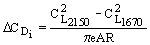
Where e = Oswald's Efficiency factor of 0.8 for a rectangular wing, and AR is the wing's aspect ratio of 6. The result is a change in the induced drag coefficient of 0.0158 which doesn't sound like very much but when expressed as a change in horsepower,
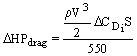
it works out to 9.9 horsepower, which is very significant! By adding this 9.9 HP to each HPdrag term, which in turn means there's 9.9 fewer HP for each HPclimb term, we can calculate a rate of climb value for each altitude for the higher gross weight. Table 2 is a summary of that data.
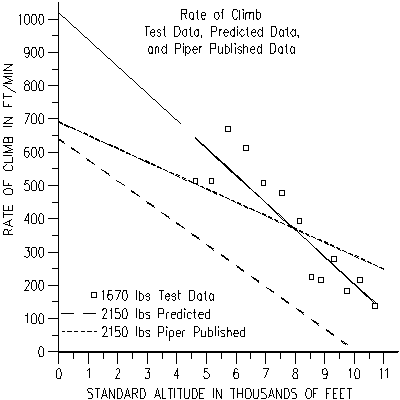
After all this work, we can finally show all the relevant data
in a single graph. Figure 1 allows us to see the original flight
test data at 1670 lbs, the linear regression curve fit applied
to this data, the predicted data at 2150 lbs gross weight, and
Piper Aircraft's data for a 2150 lb airplane as published in the
operating manual.
Figure 1
So what conclusion can we draw from all this? Well, for starters,
more test data at lower altitudes would improve the curve fit
and would most likely change the slope of the lines a bit. Secondly,
the gross difference between my predicted data and Piper's would
indicate that Piper's test aircraft could produce more useable
climb power at altitude than mine can. The only way this
could be possible would be to either reduce the aircraft drag
at high altitudes or increase the propeller efficiency with altitude.
The first explanation isn't possible without changing the aircraft
configuration, and the second explanation requires some really
dramatic changes in propeller efficiency--like 75 percent at sea
level to 91 percent at 16500 feet (Piper's estimated service ceiling
for the Cherokee 140)! I even gave Piper the benefit of the doubt
by allowing them to use a climb prop to generate their rate of
climb chart and I used their power charts as well. One last point.
In Piper's Operating Manual, the rate of climb chart for the Cherokee
140 has the same slope as the Cherokee 180 except that it's offset
75 ft/min lower. This difference might be valid at sea level but
by the time both aircraft reach 7500 feet, the difference should
be at least 250 ft/min in favor of the Cherokee 180. And this
is using Piper's own data!!! Guess what? Applying these corrections
to the operating manual gives almost the same rate of climb data
which I predicted in the above analysis!
My conclusion is that N554FL is pretty healthy for a 22 year-old
airplane. Also, the data in the operating manual is correct only
for the Cherokee 180 and Piper pushed a lot of B.S. into the manual
for the Cherokee 140! Where's my waders??? The question I'm sure
you've been dying to ask is: Why didn't I just load up the airplane
to 2150 lbs gross weight and get all my test data there--and avoid
all the mathematics? Boy, am I glad you asked that. The answer
is: Because I didn't know if it was the engine or the operating
manual which was faulty. If indeed I had an engine problem, its
effects were undocumented. By flying at the lighter weight, I
could approach the problem more safely. The next step is, of course,
to verify my predictions by flying the test flight again at 2150
lbs.
You may even wish to duplicate this test in your own airplane
for the purpose of documenting its rate of climb performance.
There's no substitute to having good data--ask anyone who flew
with me at last year's Copperstate Fly-In!
by: Bullwinkle the Moose
Today I wished to fly real high;
But in a Piper Cherokee;
It flies much better when it's light;
"Hey, who put that in there?"
Check out the Sequel "Frostbite Falls Flyer Foils Foul Fossil Fueled Fallacy"
Thirteen thousand feet in the sky.
Play with the clouds, that was my goal.
Here we go now, the takeoff roll.
There isn't any energy.
The rate of climb is very low;
Beanstalks won't even grow that slow.
Ask the squirrel, you know he's right.
He'll also tell you, all about flying;
That moose really can't, and shouldn't be trying.
"Never mind, Bullwinkle."

 EAA Chapter 1000 Home Page
Contents of The Leading Edge and these web pages are the viewpoints
of the authors. No claim is made and no liability is assumed,
expressed or implied as to the technical accuracy or safety of
the material presented. The viewpoints expressed are not necessarily
those of Chapter 1000 or the Experimental Aircraft Association.
Revised -- 22 February 1997